
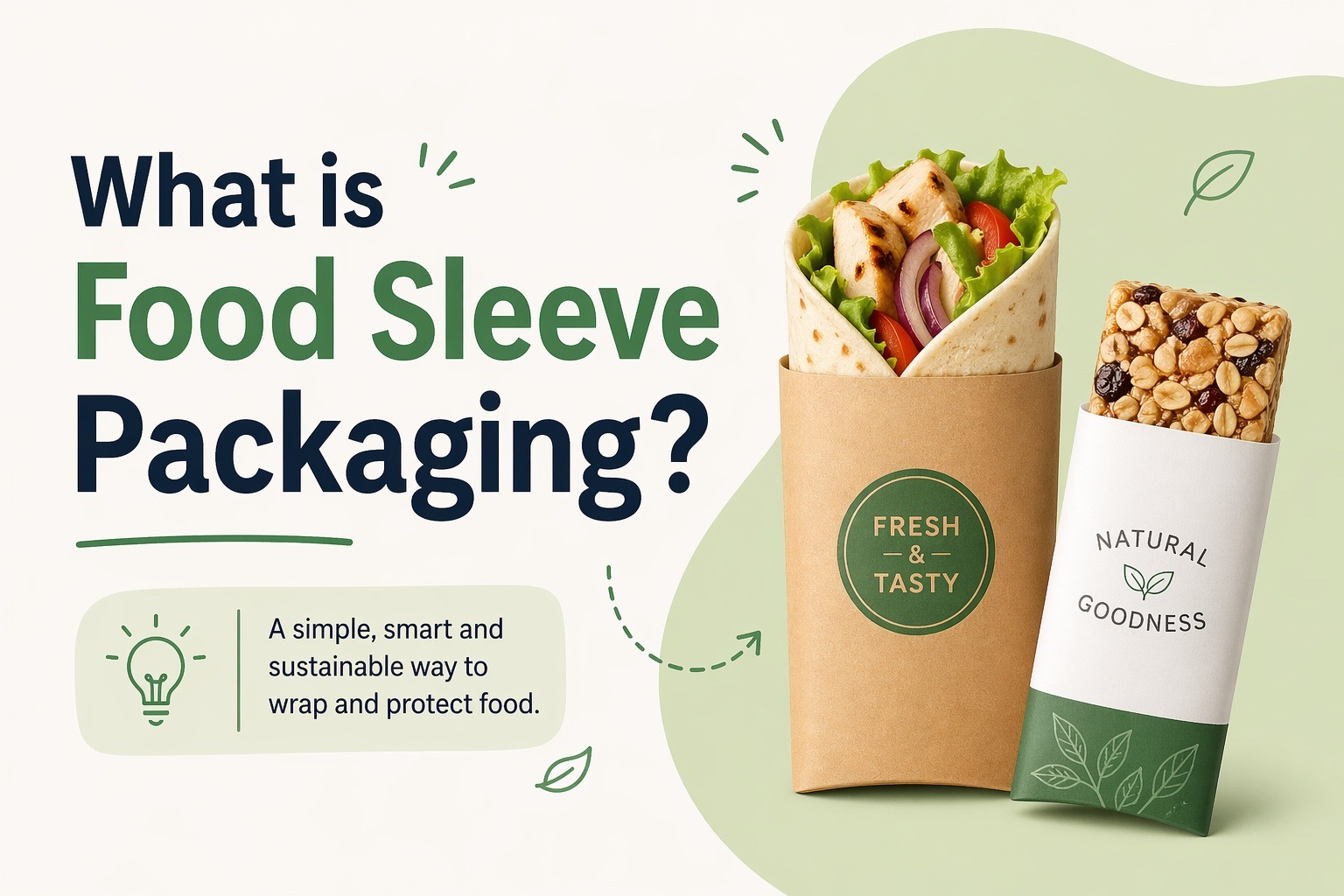
What is Food Sleeve Packaging? Why Is It Gaining So Much Attention?
Packaging is as important as the product itself in the market, where customers make their buying choices within a few seconds. Food companies are not just using the same old boxes or containers anymore; they’re moving towards smarter and more versatile solutions in terms of appearance and functionality. Food sleeve packaging is just one of these types of innovations that are quickly gaining popularity in the UK and beyond.
This type of packaging gives an ideal balance between affordability, sustainability and aesthetics. It enables brands to transform ordinary packaging to eye catchy and informative without a total redesign of their packaging system. Sleeves are gaining popularity among businesses that seek to be distinctively different yet practical.
What is Food Sleeve Packaging?
Food sleeve packaging is an outer printed wrap or band that slips or goes around a food container, tray, box, or cup. It does not entirely wrap the product, as is the case with full packaging. Rather, it serves as a supplementary layer which boosts branding, protects the contents and avails important product details. These food packaging sleeves are crafted out of cardboard or paperboard. An aesthetically built food sleeve would not only enhance the appearance of the product but also give a more professional and high-end feel, despite the simple inner packaging.
What are the Benefits of Food Sleeve Packaging In The UK?
The food sleeve packaging has a number of benefits. Let’s explore some of the prominent ones:
Improved Functionality
Packaging sleeves serve to hold the lids, enhance grip and ease of handling, particularly when it comes to takeaway foods.
Visual Appeal
The sleeves will be a big space for creative designs and vibrant colours. Moreover, branding can be done to capture the attention of customers.
Information Delivery
Food sleeves provide areas where important information about the food, like ingredients, allergens, nutritional and usage instructions, can be placed.
Sustainability Benefits
Full packaging is not necessary when sleeves are added. It reduces the amount of material as it can also be recycled or biodegraded.
Cost-Effective Branding
Businesses do not have to invest in an entirely customised box, but rather just use plain packaging and add printed sleeves. This goes a long way in minimising the cost of production.
Standard Food Sleeve Sizes and Their Uses
| Size | Suitable For | Typical Use |
| 4–6 inches | Sandwiches, wraps | Takeaway items |
| 6–8 inches | Burger boxes, meal trays | Fast food packaging |
| 8–10 inches | Large meals | Retail and family packs |
| Cup Sleeves | 8oz–16oz cups | Hot beverages |
| Custom Sizes | Any product | Specialised packaging needs |
Where is Food Sleeve Packaging Used Across Different Industries?
The packaging of food sleeves is very versatile, and it can be used in very diverse industries:
Beverage Industry
Hot drinks are popular with cup sleeves. They not only keep the hands safe, but also serve as a branding for coffee shops and beverage chains.
Event Catering & Food Trucks
Branding sleeves provide a fast and affordable option for food packs without needing to invest in bespoke boxes in promoting or temporary setups.
Food & Takeaway Businesses
Sleeves are used in restaurants, cafes, and takeaway outlets to wrap burgers, wraps, sandwiches and meal trays. They assist in enhancing grip, minimising mess, and branding without increasing packaging expenses.
Bakery & Confectionery
Sleeves are usually used by bakeries to package cakes, pastry trays, and desserts. A plain sleeve will instantly increase the perceived value of baked goods.
Retail & Supermarkets
This kind of packaging is usually found in ready meals, frozen foods and pre-packaged foods. They leave space for nutritional information, cooking tips and branding without fully covering the product.
Materials Options For Food Sleeve Packaging?
The type of material is important in terms of wear and tear, safety, and appearance.
Coated Paper
It has a protective layer that is resistant to moisture and greases, thus making it suitable for oily, hot or freshly cooked food.
- Grease-resistant surface
- Moisture barrier protection
- Enhanced print durability
Cardboard (Paperboard)
One of the most successful materials is cardboard sleeves for food packaging. It is appropriate for the majority of food products and has a clean, professional finish.
- Cost-effective option
- Strong structural support
- Smooth printing surface
Laminated Paperboard
This material is finished with the protective laminate, providing better durability. Moreover, it also increased the visual finishes of matte or gloss.
- Improved surface protection
- Gloss matte options
- Premium look finish
Corrugated Material
Offers extra support and padding, so it works well with heavier or more fragile food products requiring more protection.
- Extra cushioning strength
- Durable layered structure
- Ideal heavy items
Kraft Paper
It has a natural and environmentally-friendly image. Kraft sleeve food packaging is popular among brands that focus on sustainability.
- Eco-friendly material
- Natural rustic appearance
- Easily recyclable
Food Sleeve Packaging vs Traditional Packaging
| Feature | Food Sleeve Packaging | Traditional Packaging |
| Material Usage | Uses less material | Requires more material |
| Cost | More affordable | Higher production cost |
| Branding Flexibility | Easy to update designs | Difficult to modify |
| Product Visibility | Partially visible | Fully enclosed |
| Storage | Flat and space-saving | Bulky and rigid |
| Sustainability | More eco-friendly options | Often less sustainable |
| Production Speed | Faster turnaround | Longer production time |
Importance Of Custom Food Packaging Sleeves
Custom printing transforms a simple sleeve into a powerful branding tool. Regular and familiar packaging in a competitive market can bring customer perception and loyalty.
Key Advantages:
- Reinforces brand identity
- Enhances product exposure on shelves.
- Supports promotional campaigns
- Develops customer confidence with transparent information
Personalised sleeve packaging contains logos, taglines, QR codes, social media accounts, and promotions, which are the key elements of contemporary marketing.
What Printing Methods Are Used for Food Sleeve Packaging?
Various printing methods are applied based on your budget, volume of order and the amount of detail needed in your design. Find the appropriate solution, and your food sleeves will look professional and affordable.
Digital Printing
Digital printing is ideal for short runs and quick turnaround. It does not involve the use of printing plates and therefore, set-up costs are reduced, and design alterations between batches are easily made. This makes it a great choice in case of start-ups, seasonal campaigns, or limited-edition packaging.
Offset Printing
One of the most common large-scale production techniques is offset printing. It produces high-resolution images and uniform colour quality in bulk orders. Though the initial set-up cost may be more expensive, it is very cost-effective for custom packaging boxes.The printing is a perfect way when it comes to a brand that is already established and needs high-quality packaging.
Flexographic Printing
Flexographic (flexo) printing is a common printing technique in high-volume production, particularly in the food industry. It involves the use of flexible printing plates and drying inks. Although it is not as fine as the offset printing, it is very economical for simple designs and high-volume orders.
CMYK Printing
CMYK (Cyan, Magenta, Yellow, and Black) is a full colour printing process that is used to produce graphics that are vivid and detailed. It also supports gradients, images, and sophisticated artwork, which makes it appropriate for brands.
Pantone (PMS) Printing
When consistency in colours is paramount, Pantone Matching System (PMS) printing is used. It makes sure that all your brand colours are the same on all packaging, irrespective of the print run. This is significant to those businesses that want to influence the brand identity.
Finishing Options for Enhanced Appearance
Besides printing techniques, there are other finishing techniques that can be used to enhance the appearance and feel of food sleeves:
- Matte or gloss lamination
- Spot UV
- Foil Stamping
- Embossing or Debossing
The choice of the printing and finishing combination will make your food sleeve packaging not only look appealing, but also represent the quality and professionalism of your brand.
How to Choose the Right Food Sleeve Packaging for Your Business?
To select the right printed sleeves food packaging uk, it is necessary to pay attention:
Understand Your Product
The needs of different foods vary. Hot or greasy foods must have coated or laminated materials.
Consider Budget
Bulk ordering has the potential to push down the costs.
Evaluate Distribution Needs
Retail packaging needs to be more detailed with information, and take-away packaging is more concerned with convenience.
Focus on Branding
Colours, typography and design of your packaging must show your brand identity.
Think About Sustainability
Environmentally friendly materials have the potential to enhance brand image and attract eco-conscious consumers.
Food Safety and Compliance Standards For Best Printed Sleeves Food Packaging UK
In terms of food sleeve packaging, design is no more significant than safety. Food packaging in the UK has to comply with strict regulations to make sure that the material does not contaminate or have a negative impact on the food.
Food sleeves must be constructed out of food-safe materials that can be in direct or indirect contact with food. This involves adherence to UK and EU laws on the migration of chemicals. It ensures that there will be no harmful substances on food through packaging.
Moreover, it is necessary to take into account:
- Oil resistance to grease
- Fresh or chilled item moisture barriers
- Hot takeaway resistance to heat
What Are the Latest Trends in Food Sleeve Packaging?
Keeping up with the trends will provide your brand with a competitive advantage. Some of the recent changes are:
- Minimalist Designs: Minimal branding and clean layouts to create a clean look.
- Eco-Friendly Packaging: More recyclable and biodegradable packaging.
- Interactive Assets: QR codes of menus, promotions or brand stories.
- Bold Typography: Bold fonts that enhance readability and shelf appearance.
Adherence to these trends keeps businesses up-to-date in a rapidly evolving market.
Where to Buy Food Sleeve Packaging in the UK?
If you are looking for reliable and high-quality packaging solutions, we offer a comprehensive range of custom food sleeve packaging options.
They provide:
- Competitive wholesale pricing
- Bulk order discounts
- Fast turnaround times
- Free shipping across the UK
Their services are designed to support both small businesses and large food brands, ensuring you get packaging that aligns perfectly with your needs.