
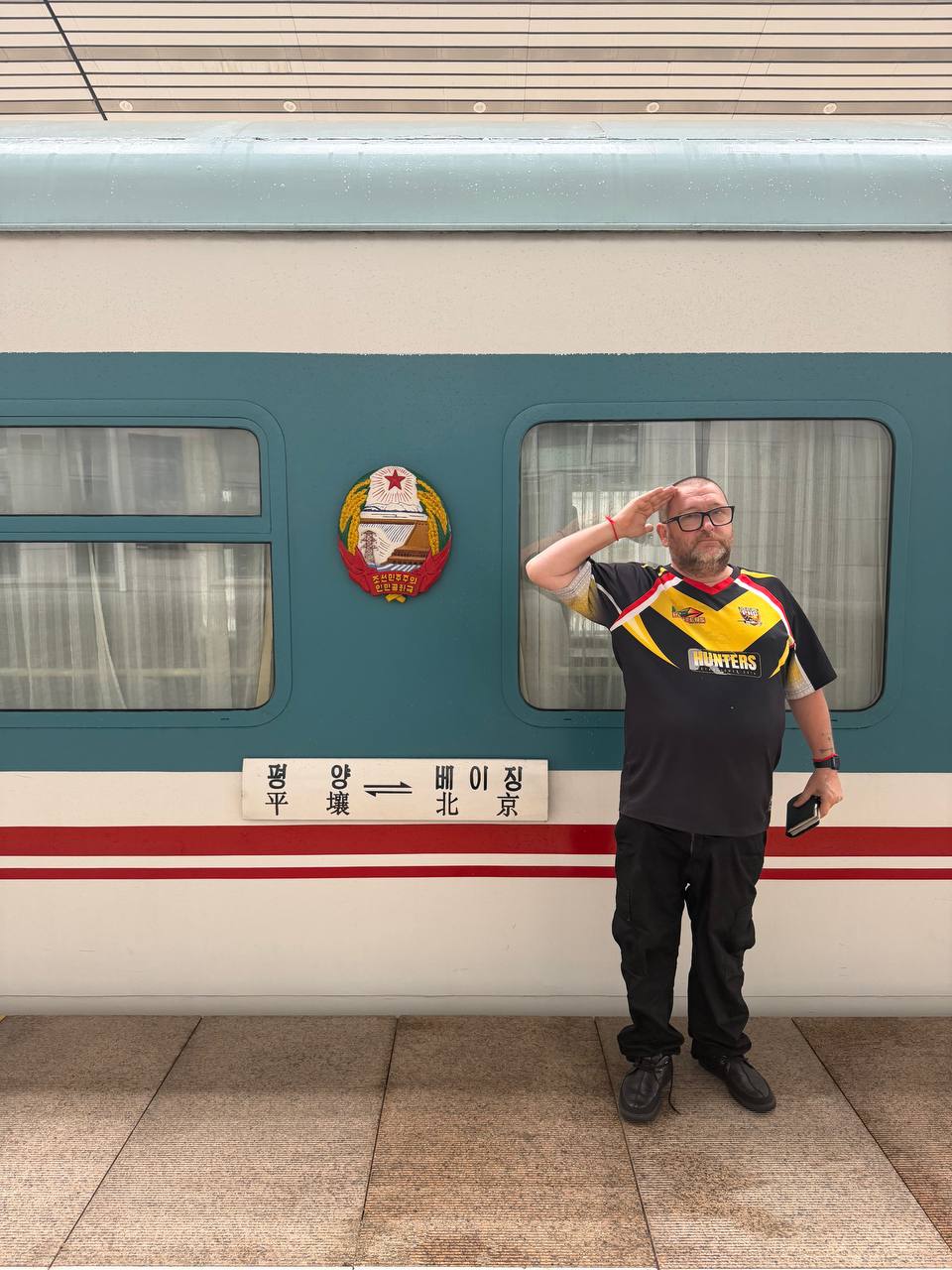
A journey I had previously taken close to a hundred times, but one I had not embarked on for 6 years. Well I was just part of the first Western group to take the train from Beijing to Pyongyang and it was as epic as ever.
So, how do you take the train from Beijing to Pyongyang? Well it is no easy feat and you cannot do it independently, but it is now at least possible. Well at least if you know the right people.
Click to read about taking the train in Vietnam.
Table of Contents


History of the K27 train from Beijing to Pyongyang
The K27 train between Beijing and Pyongyang has long been one of the most politically symbolic rail routes in Asia. It connects China and North Korea through Dandong and Sinuiju, forming the main overland link between the two countries. Historically it has been used both for official diplomatic travel and controlled tourism, especially from the mid 2000s onwards when North Korea briefly opened more structured access to foreign visitors.
For many years this was the default way into Pyongyang for organised tours, with sleeper services running regularly and international carriages attached for through passengers. The line became a kind of time capsule of Cold War rail travel, with very little changing onboard even as China modernised around it.
The service stopped in early 2020 when borders closed completely. It remained suspended for several years until a controlled reopening in March 2026. The first Western group to officially cross since the shutdown did so on May 3rd 2026!, marking the return of one of the most unusual international train routes and iconic in the world.


The Chinese part of the K27 Beijing to Dandong
The Chinese part of the K27 runs from Beijing to the Chinese North Korean border city of Dandong on a daily basis. This was previously the primary route between the two cities, but with the opening of high speed rail it has become less important in terms of volume. On this train there are international carriages, which I will get to later, which do the full route, and domestic Chinese carriages that only operate within China.
The Chinese carriages are done on standing, hard seat, hard sleeper (6 berth) and soft sleeper (4 berth) cabins. These are thus priced accordingly. Overall this whole part has changed very little, with me previously having taken this journey to Dandong. This is classic old school slow Chinese train travel. I do soft sleeper now. I have done the hard seat. I am now far too old for that kind of malarkey.
Timetable of the Beijing to Dandong Train
Beijing – 17.26
Tianjin – 19.30
Shenyang – 01.30
Dandong – 07.30
Arrival typically early morning depending on departure time
Prices of each (RMB and USD)
Standing: ¥120–180 RMB ($17–25 USD)
Hard seat: ¥140–220 RMB ($20–31 USD)
Hard sleeper: ¥260–380 RMB ($36–53 USD)
Soft sleeper: ¥420–600 RMB ($58–83 USD)

Eating on the Chinese car
There are numerous trolley guys and girls coming around with all kinds of goodies. These include snacks, drinks, and the occasional completely useless souvenir item. There are also standard Chinese train snacks and drinks, including beer and baijiu, although I would strongly advise against the latter unless you know exactly what you are doing.
The main food option is the dining car where there is a fixed menu and simple plated meals. This is basic Chinese train food, rice dishes, meat dishes, and vegetables. Even a simple plate will cost around 40 RMB or about $6. China is not the cheap haven that it once was.
Changing from the Chinese train to the North Korea train in Dandong
The train arrives in Dandong at around 07.30, from where, unless you are on the international carriage, it is all change. What you do here is simply get off with your bags, collect tickets if required, and move through to the international waiting hall.
You do not need to go through immediately as border processing usually does not begin until around 09.00, so there is time for a Jian Bing or a walk along the river if that is your thing. Chairman Mao is also outside the station to see.
Chinese immigration and customs is done on the second floor. This is straightforward enough and they tend not to give too much issue if you have the correct visa. We had the right visa. You then get on the train for the ten minute journey from Dandong to Sinuiju. This is what you might call the slightly more difficult part.
So, how do you get a ticket from Dandong to Sinuiju? You do not unless you know someone who trusts you enough to arrange it once you have a visa. Or you book with someone who knows what they are doing. These are generally soft sleeper or hard sleeper allocations.

Sinuiju to Pyongyang stops and times
Sinuiju – 11.10
Dongrim – 14.09
Jongju – 15.26
Pyongyang – 18.07
Prices of tickets (USD and RMB)
Hard sleeper: ¥300–500 RMB ($40–70 USD)
Soft sleeper: ¥500–900 RMB ($70–125 USD)
The International Car of the Beijing to Pyongyang train
On all international trains in this part of the world you get both domestic carriages and dedicated international carriages. The international ones operate the full journey from Beijing to Pyongyang without requiring a change in Dandong.
These are run as sealed through services and are staffed depending on allocation, either by Chinese or North Korean staff. On the K27 this varies depending on scheduling and diplomatic arrangements.
Because they do the full route without transfer, these tickets tend to be more expensive and much higher demand. Even if you are booked, there is no guarantee you will end up in this carriage.


Sinuiju Customs and Immigration
I have done this journey many times and this part has not changed much in principle, although it remains extremely strict. After crossing into North Korea, immigration officers board the train and conduct full inspections.
Every bag is checked. Certain publications are not allowed. Anything from South Korea is strictly prohibited, including media, packaging, and sometimes everyday consumer goods. Even shampoo can be an issue depending on branding.
Cameras and phones may be checked and sometimes individual images are reviewed. Laptops are less commonly searched but still possible. There is a strong element of discretion depending on the officers and the group you are travelling with.


Eating on the train Sinuiju to Pyongyang
Back in the day the food cart on this section was famous. It used to offer full plated meals for around 50 RMB or $7 including meat, fish, kimchi, vegetables, and beer. It was one of the highlights of the journey. That system is now largely gone.
Instead there are small carts run by North Korean attendants selling limited items. These include cured meats, packaged snacks, beer fish, and a strange but surprisingly decent instant rice and chicken meal that is heated and served onboard.
Prices are usually:
Small snacks and meats: $2–5 USD
Hot meals: $3–6 USD
Taedonggang Beer/Soju and drinks: $2–4 USD
And the reverse? Pyongyang to Beijing
The return journey operates as K28 and is broadly the same route in reverse. You board in Pyongyang in the morning and arrive in Beijing the following day depending on connection timing.
On the return leg immigration and customs are usually slightly smoother but this can vary. It is important to keep receipts if you are carrying anything purchased in North Korea back into China.
International carriages on the return are more comfortable but do not allow you to disembark in Dandong, and customs processing is usually handled onboard or in controlled sections.
Accurate Pyongyang to Beijing stops and times
Pyongyang – 10.27
Jongju -13.13
Dongrim – 14.25
Sinuiju -17.13
Dandong -18.18
Fenghuangcheng -19.13
Benxi – 21.01
Shenyang – 22.24
Shanhaiguan – 03.04
Tangshan – 05.23
Tianjin – 06.55
Beijing – 08.40
What is it like taking the train from Beijing to Pyongyang
In my view this is still one of the most unique train journeys anywhere in the world. I have been doing this route since 2008 and it has always had a strange mix of routine and unpredictability.


You move from modern China into one of the most controlled environments on earth in a matter of hours. The scenery is excellent, the atmosphere changes completely after Dandong, and the entire experience feels like a different era of travel.
I was part of the first Western group to cross and indeed visit the DPRK again since early 2020. Not going to lie, I am pretty pleased with that.
Click to see my North Korea Tours.