
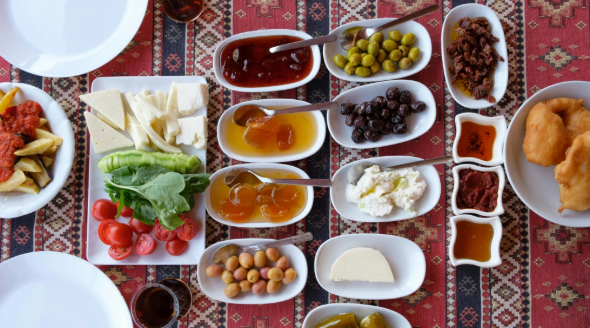
The first time I ate Albanian fërgesë — a baked pepper-and-feta dish that landed in front of me at a guesthouse in Berat one Tuesday evening — I had this small embarrassing moment where I realized I’d been operating with a pretty narrow mental map of Mediterranean food my whole life. Italian, Greek, maybe a bit of Spanish, occasionally Lebanese. Solid enough coverage. The Mediterranean basin actually contains roughly fifteen distinct cooking traditions, give or take depending on who’s drawing the lines, and a handful of them never quite made it through the export filter that decides which cuisines become globally famous and which stay mostly parked at home.
Some of the most interesting kitchens in the basin sit in cuisines that haven’t had their proper international moment yet. Albanian, Cypriot, Maltese, regional Sicilian (the inland version, not the coastal one everyone already knows), and the mountain cooking from Lebanon’s interior — none of them is exactly hidden from view, but they don’t sit on the same shelf as Tuscan or Provençal in most travelers’ mental rolodex.
If you’re the kind of traveler who plans a trip partly around the food, this guide is meant as a starting point: what makes each of these five cuisines distinctive, what’s worth ordering on a first encounter, and where the standout regional dishes actually originate.
In this guide:
- Why some Mediterranean cuisines stay off the radar despite being excellent
- Five kitchens worth a dedicated meal — or a dedicated trip
- Signature dishes and the regions that do them best
- Practical tactics for finding the real version on the road
What makes a Mediterranean cuisine “underrated”?
The Mediterranean diet was inscribed by UNESCO as Intangible Cultural Heritage in 2010 — the listing officially covers Spain, Italy, Greece, Morocco, Portugal, Cyprus, and Croatia. You can read the full inscription on the UNESCO Intangible Cultural Heritage page directly (https://ich.unesco.org/en/RL/mediterranean-diet-00884). But the actual practice of olive oil, vegetables, grains, and slow-cooked legumes extends well past those seven countries on the official list.
Several adjacent cuisines share the same basic DNA but stay under-exported for slightly different reasons in each case — the food itself doesn’t travel well across borders, the diaspora population is smaller and hasn’t set up restaurants abroad, or the country has only recently opened up to mass tourism in a way that would push its cuisine onto international restaurant menus. Which is actually good news for the traveler willing to go to the source. You eat better in countries where the food hasn’t yet been adapted for visitors, because chefs aren’t optimizing the menu for what tourists expect a “Mediterranean” meal to look like.
Five Mediterranean cuisines worth a dedicated plate
1. Albanian — Balkan ingredients with Ottoman technique
Albanian cooking sits at an unusual crossroads geographically. The country’s coastline pushes the cuisine clearly Mediterranean — heavy use of olive oil, lamb, fresh fish along the Ionian and Adriatic shorelines — while five centuries of Ottoman occupation left a heavy mark on the spice cabinet and the love affair with slow-baked savory pastries.
The result is a kitchen where fërgesë (the baked pepper, tomato, and feta dish I mentioned at the top) sits comfortably next to byrek (savory phyllo pies in roughly forty regional variations), and where grilled fish gets dressed with nothing more than lemon, oregano, and olive oil that came from a tree the cook can usually point to from the restaurant doorway.
For a proper introduction to the traditional food in albania, Tourist State has a guide running through 15 dishes worth ordering on a first visit, with notes on the regional differences between coastal and mountain cooking — they’re more separate than you’d expect — and what to drink alongside each one.
2. Sicilian — beyond the version exported abroad
Most travelers think they already know Sicilian food because they’ve had cannoli and arancini somewhere in their home country at some point. The actual island cuisine includes Arab-influenced dishes that almost never travel — pasta con le sarde (sardines, fennel, raisins, and pine nuts in a single bowl that shouldn’t work but somehow does), caponata in its many regional variations across the island, and the inland cooking of Modica, Ragusa, and Enna that’s almost unrecognizable from the coastal Palermo version most foreigners encounter at home. Couscous appears on the western tip of the island in a way that surprises first-time visitors who didn’t know there was a couscous belt running across the Mediterranean.
3. Cypriot — halloumi is the start, not the finish
Cyprus has its own meze tradition that overlaps with both Greek and Turkish cuisine without being identical to either. Sheftalies (caul-wrapped grilled meat patties seasoned with parsley and onion), koupepia (stuffed vine leaves with a markedly different spice profile from Greek dolmades — heavier on cinnamon and tomato), and afelia (pork slow-braised in red wine and crushed coriander seed) are the dishes worth seeking out specifically. Ordering a full meze in Larnaca or Nicosia and asking for the local specialties tends to surface dishes most halloumi-focused tourists never encounter on a casual dinner out.
4. Maltese — North Africa meeting Sicily on a small island
Malta’s location at the center of the Mediterranean made the island’s cuisine a hybrid of nearly everything around it. Pastizzi (small flaky pastries filled with ricotta or mushy peas) are the everyday street food that locals eat at any hour of the day, and they cost about a euro fifty each. Stuffat tal-fenek — a slow-cooked rabbit stew with red wine, garlic, and bay leaves — is the closest thing the island has to a national dish, served at family gatherings the way roast lamb runs the Easter table elsewhere. Bragioli (beef olives stuffed with breadcrumb, egg, and parsley) show the Sicilian influence clearly, while aljotta (a saffron-tinged fish soup) reveals the North African one.
5. Lebanese mountain cuisine
Coastal Lebanese food (Beirut-style mezze, hummus, tabouleh, fattoush) is well known internationally — that’s the version that made it onto the global menu through the diaspora. The mountain cooking from villages above the coast, particularly around Zgharta and Bsharri, is heavier on bulgur, fermented dairy, and slow-stewed lamb in ways the coastal version simply isn’t. Kibbeh nayyeh as it’s prepared in Zgharta, moghrabieh with proper hand-rolled pearl couscous (which takes about four hours to make from scratch and another hour to cook properly), and the mountain village kishk porridge — none of these survive the trip to a Western Lebanese restaurant intact.
How to actually eat these cuisines on the road
A handful of practical rules I’ve worked out across enough trips to feel confident sharing them:
- Eat where locals are eating at lunch, not just at dinner — lunch is the more honest meal in most Mediterranean countries, with regulars rather than tourists making up the room.
- Skip restaurants with picture menus, English-first staff, and laminated tablecloths in obvious tourist quarters near major cathedrals or train stations.
- When you ask “what’s local?”, actually order whatever the waiter recommends, even if you don’t recognize the dish name on the menu.
- Markets are the fastest way into understanding any cuisine — an hour walking through any covered market before your first proper sit-down meal will reframe how you order for the rest of the trip.
FAQ
Are these cuisines vegetarian-friendly?
All five have strong historical vegetarian traditions, though the dish names aren’t always obvious to non-locals. Albanian and Lebanese are particularly accommodating — pulses, vegetables, dairy, and grains have done most of the historical heavy lifting in both kitchens, with meat acting more as flavoring than centerpiece in everyday cooking until relatively recently.
What about local wine pairings?
Each of these countries has indigenous grape varieties that mostly don’t get exported. Albanian Kallmet, Cypriot Xynisteri, Maltese GĠellewża, and various Lebanese reds from the Bekaa Valley — order them locally rather than reaching for an imported Italian or French bottle off the wine list. The native wines are built specifically for the food they sit alongside, and the markup on imports is usually painful anyway.
Where should I start if I can only pick one country?
Albania, currently. The food is genuinely excellent, prices are still meaningfully lower than equivalent meals in Italy or Greece, and the cuisine catches travelers off guard in a way that feels genuinely rare in Europe these days. The country has been opening up to tourism gradually enough that the restaurants haven’t yet adapted their menus for foreign expectations the way Croatia or Greece partially have.