
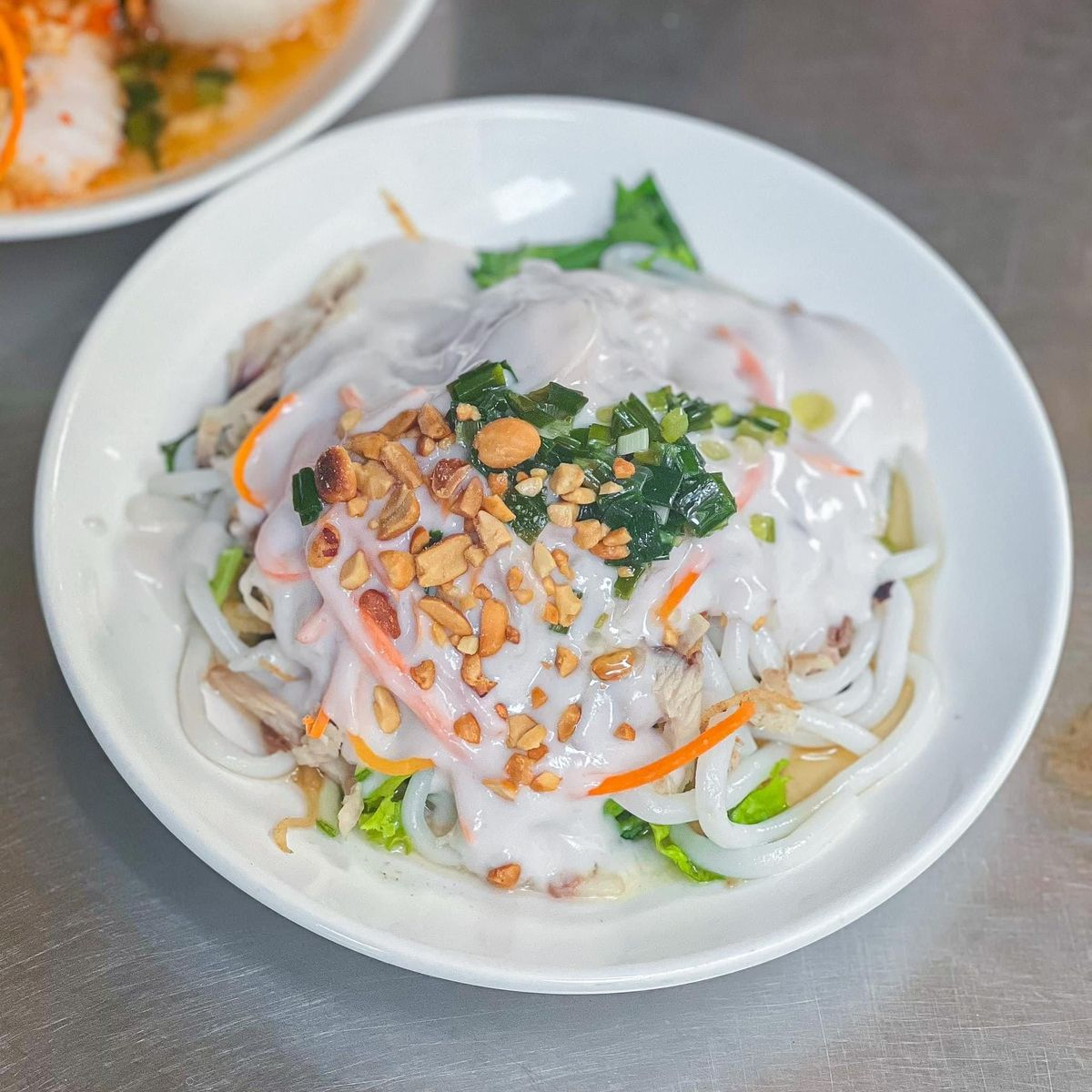
Banh Tam Bi is one of those southern Vietnamese dishes that does not get anywhere near the international attention it deserves, probably because it sits in that awkward space where it looks simple at first glance but turns into something far more interesting once it actually arrives in front of you. It is the kind of food you find all over Saigon in small street restaurants, open-front kitchens, and family-run places that do not really care about presentation because they do not need to.
If you are in Saigon, especially after a night out in District 1 where everything is loud, messy and slightly out of control, this is exactly the kind of dish that appears at the right moment. Heavy, cheap, filling, slightly sweet, slightly savoury, and built in a way that makes perfect sense once you stop overthinking it and just eat.
Table of Contents
Got coconuts?
One thing you realise very quickly in southern Vietnam is that coconuts are not just common, they are everywhere to the point that you stop noticing them. Due to the climate, coconuts are one of the most reliable and cheapest things you can get in Saigon, sold straight from carts, cracked open on the spot, and served with ice while you sit on a plastic stool trying to make sense of traffic that seems to have no rules but somehow functions anyway.
But coconuts do not stop at drinks. They run through Vietnamese cooking in a way that is hard to ignore. They appear in desserts, soups, sauces, and in this case, noodles. There is no real separation between sweet and savoury in the way Western food often insists on, instead everything just gets combined until it works, and more often than not it does.

What is Banh Tam Bi?
Banh Tam Bi is a southern Vietnamese dish made from thick rice and tapioca noodles mixed with shredded pork, fresh herbs, cucumber, and then completely covered in a thick coconut milk dressing. On paper it sounds like it should not work, but once you actually eat it you realise very quickly that it absolutely does, and that is very much the pattern with a lot of Vietnamese food where combinations that seem slightly strange end up making complete sense once you are halfway through the bowl.
The noodles are the base of everything. Thick, chewy, slightly sticky, and completely different from the lighter rice noodles you find in pho. These are designed to hold sauce, and they do that job extremely well. They soak up the coconut milk almost immediately and turn into something rich and heavy.
The pork adds saltiness and texture, usually shredded and sometimes mixed with bits of skin, which gives the dish a bit of bite and stops everything from becoming too soft. The herbs bring freshness into the mix, mint, basil, coriander and cucumber all cutting through the richness so the dish does not collapse under its own weight. Then the coconut milk is poured over the top and everything changes, turning it into something creamy, slightly sweet, and far more filling than it looks when it first arrives.
Where to find Banh Tam Bi
You will not usually find this as classic street cart food. It sits more in the category of small street restaurants and family-run open-front places where everything spills onto the pavement and the kitchen is basically an extension of the street.
Across Saigon and southern Vietnam these places all follow a similar pattern. Big trays of noodles are kept visible, pork is prepped and ready, and there is always a pot of coconut milk sauce that never seems to empty because it is constantly being ladled over bowls as they go out. It is not designed to look clean or polished, it is designed to move food quickly and efficiently.
The seating is always the same, tin chairs and tin tables, nothing matching, nothing fancy, just a functional setup that exists purely to get food into people as fast as possible.
Eating Banh Tam Bi
So I grabbed a tin chair, sat down at a tin table, and ordered a Saigon beer on ice, because that is basically standard procedure in this part of the world.
The bowl arrives and at first glance it looks simple enough, but once you start digging into it you realise there is a lot more going on. The noodles come first, thick and slightly tangled, sitting heavy at the bottom of the bowl. Then the herbs come through, mint, basil, coriander and cucumber, adding freshness and crunch that lifts everything up. After that the shredded pork comes in, salty, slightly chewy, and adding depth. Then finally the coconut milk is poured over everything and the dish becomes one unified bowl of southern Vietnamese food that is rich, creamy and slightly sweet.
As always, I add chillies at this point because coconut and chilli is one of those combinations that just works even though it should not on paper. The heat cuts through the sweetness and stops everything from becoming too heavy, which is important because the dish is already quite rich.

How does Banh Tam Bi taste?
So how does it actually taste? The answer is thick, creamy, starchy and extremely filling in a way that makes you realise halfway through the bowl that you probably did not need this much food, but you are going to finish it anyway because it works.
The noodles are chewy and dense, the pork brings saltiness and texture, the herbs keep everything fresh, and the coconut milk ties it all together into something that feels slightly indulgent but also completely normal in the context of southern Vietnam where this kind of flavour combination is everyday food rather than anything unusual.
Overall, dammed good.
Click to see my Vietnam Tours.